 EN
EN  PL
PL  CS
CS  DE
DE 
Guide to jewellery
Guide to jewellery
Investment jewellery
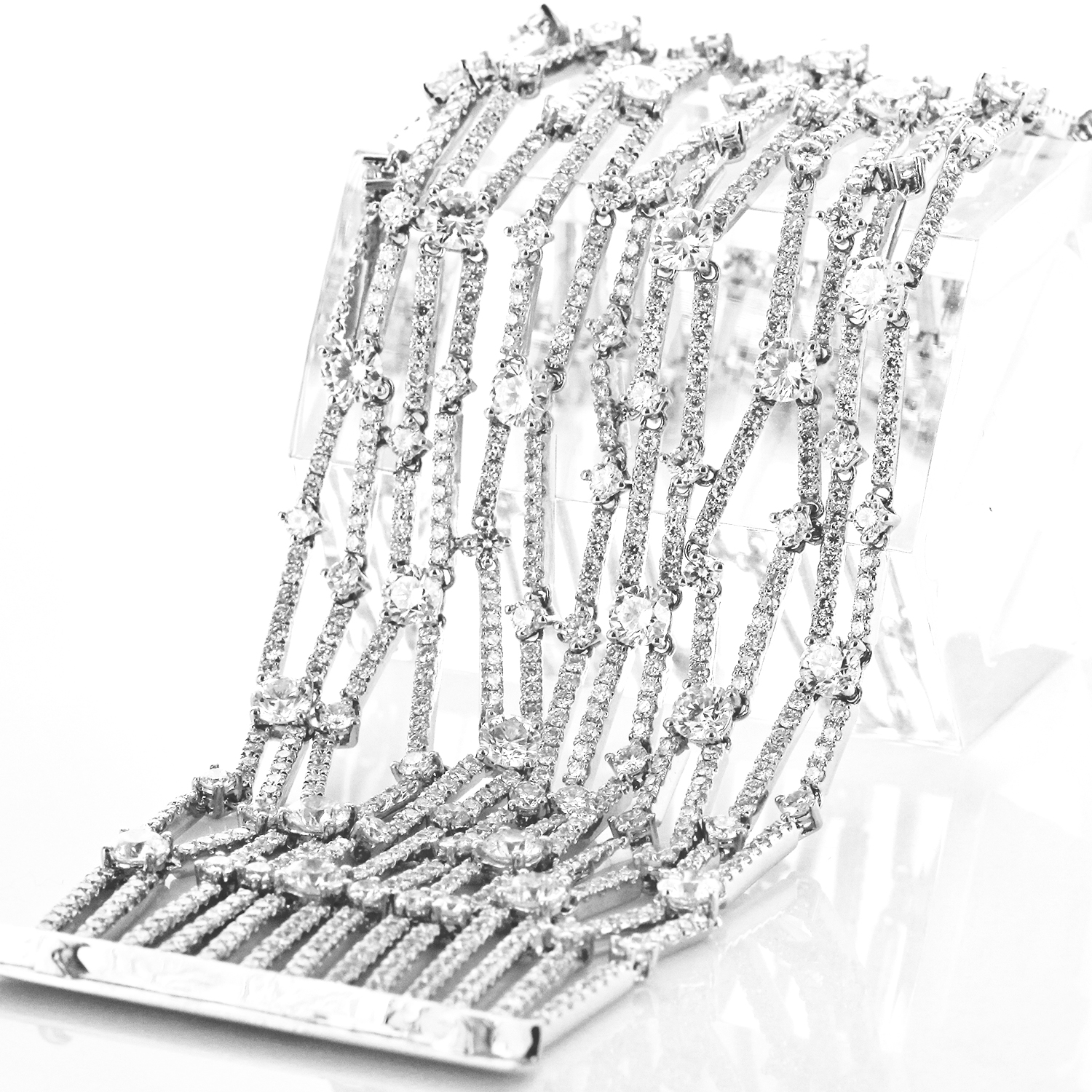
In the twenty-first century, we are rediscovering a luxury investment already known in antiquity and successfully pursued for several thousand years by successive generations of rulers and the mighty of this world. An investment that requires no economic knowledge, is risk-free and offers the possibility of an easy transfer of capital to any place in the world. Exclusive jewellery is not only a beautiful ornament but also an excellent investment that combines the guaranteed stable value of precious metals and stones with the elite artistic and collector value of works of art.
The fact is that no matter what, diamonds, gold, silver, sapphires, rubies and emeralds always maintain their real value and are not subject to inflation. Their price remains independent of economic crises, exchange rates or political turmoil. On the contrary, in periods of uncertainty, when all other components of an investment portfolio depreciate, their value increases.
Investment jewellery is more secure than bonds and more real than a sealed bottle of wine, and most importantly it can successfully serve as a utilitarian asset without losing value. Skeptics will say that buying pure commodities is a better solution and they will be right when it comes to large investments, as luxury jewellery is an additional investment (from several thousand to a million zlotys) that is worth enriching your portfolio with (preferably 5% of its value). Instead of a gold bar, you can buy your beloved woman a diamond-studded necklace, which is sure to put her in a good mood, and years later this necklace will become an ancestral possession to be passed on to the next generation. On the other hand, investment jewellery can easily be disposed of worldwide in case of need. It is also much easier to transport a necklace across a border as part of an outfit than a bar of gold or a bag of diamonds hidden in a pocket.
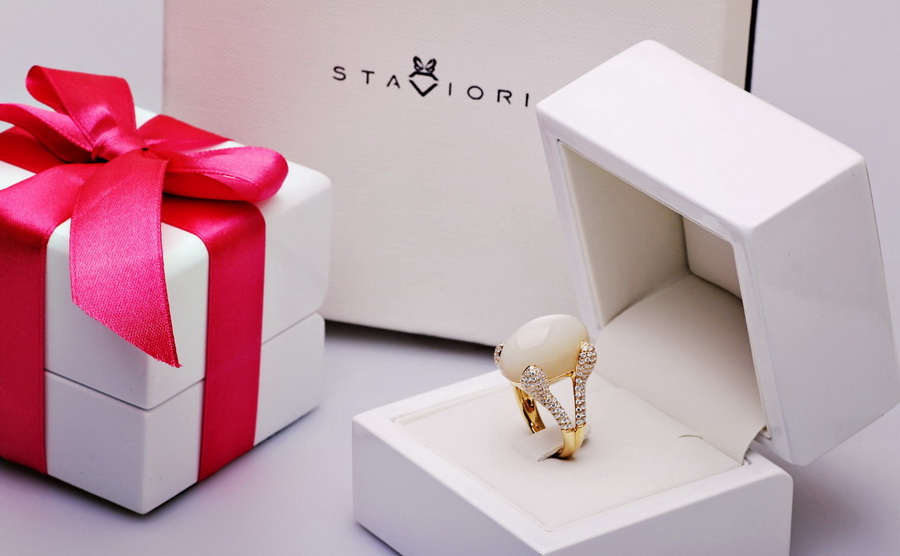
Marcello Staviori products are created by the finest masters of Italian goldsmithing. Each piece of jewellery is made with the utmost precision, and diamonds and other stones are set under a microscope, which guarantees exceptional durability. Thanks to mail order and catalogue distribution through specialised consultants, we do not generate additional costs and our prices are kept as low as possible, which is of key importance in the case of investment jewellery.
Investment diamonds
Gemstones will always have a real value, regardless of economic crises, historical excesses or declines in stock prices or exchange rates. They represent, as it were, a separate, universal currency that knows no national borders.
The only noble
Only a few of the most impressive minerals deserve to be called gemstones: diamond, ruby, emerald, sapphire, chrysoberyl and precious opal. Less striking stones, with less hardness and durability, found more frequently in nature, are referred to as semi-precious stones. These include, in particular, minerals such as topaz, garnet, aquamarine, chrysolite, turquoise, zircon, tourmaline, hyacinth, spinel, amethyst, rock crystal or morion.
Although they have always been a symbol of power and might, the diamond rush did not begin in earnest until the 19th century. Since then, it has continued to this day. Large diamonds are some of the world's most valuable gems. The largest diamond found in South Africa in 1905 had a mass of 3106 carats. After being split into 103 pieces and polished, the largest one weighing 530.2 carats was set in the sceptre of the Queen of England. It bears the name of the Great Star of Africa (Cullinan I).
Most valuable
The undisputed king of gemstones is the diamond, from the Greek known as the 'Indestructible', which, when properly polished to bring out its beauty, becomes a diamond. This most precious gemstone is an allotropic variety of carbon, crystallised in a regular pattern. It is the hardest known material in the world - 10 degrees on the Mosh scale. Diamonds have already survived for 3 billion years by resisting the forces of nature. It was then that, as a result of temperatures of 1325°C and pressures of 50,000 kg/cm2 - it is as if the Eiffel Tower were placed on the palm of one's hand - they transformed from carbon into nature's most magnificent creation, which will dazzle us with its brilliance until the end of the world.
Investments in diamonds
Recent years have seen a significant increase in the price of gemstones. The return on investment in gemstones can be very high or low, while never making a loss. Cut diamonds can already cost from several hundred to tens of thousands of dollars per carat. The value of gemstones is constantly increasing, influenced by the growing demand and low supply. This is due to the fact that the number of natural diamonds in the world is limited and, in addition, not all of them are suitable for the most perfect cut that creates a diamond.
The noble alternative
The performance of traditional equity investments is becoming increasingly uncertain and global markets have long ceased to be characterised by stability. It is this uncertainty about the economic climate that has contributed to the search for alternative forms of investment, among which Diamonds are the most secure form of savings. It is a real investment of capital and not a temporary virtual value, recorded in the records of banks that may go bankrupt. The price of a stone depends more on its individual characteristics and less on the market situation for these minerals.
However, it is important to remember that these investments require appropriate knowledge and care, and the utmost care is required when choosing a stone. Our company will expertly advise and assist you in purchasing the diamond of your dreams, and will also frame it for you in a gorgeous setting. Because instead of keeping the stone in a safe, it is better to dazzle everyone around you with it.
Gemstones can be purchased from jewellery companies specialising in this field. Only buying diamonds in such a way does not carry any risk of fraud, all the more so if the stone is accompanied by an international certificate from one of the three most important gemmological laboratories in the world (HRD, IGI and GIA). These certificates are recognised all over the world and diamonds certified with them can be even several times more expensive than those without a certificate. We make every effort to ensure that the stones used in the production of our jewellery are of the highest quality and their origin complies with UN requirements - from countries free of armed conflicts.
How to assess ?
The value of worked diamonds, including round-cut diamonds, is directly influenced by the following four factors: weight, clarity, colour, cut - referred to as the "4Cs": carat, clarity, colour, cut.
The brilliant cut is considered the pinnacle of achievement for the masters of the profession. The features of the brilliant cut include 58 surfaces (known as facets - otherwise known as faces, of which there are 56, the other two surfaces being the facet and the colet). Further features include a round brilliant, and at least 32 facets and taffeta in the upper part, as well as at least 24 facets (and sometimes a colet, i.e. a flattened point) in the lower part. Diamonds cut in other shapes are expertly no longer diamonds, but cut diamonds in the shape of, for example, a baguette, princess or pear.
The larger the stone, the higher the price per unit of mass, the so-called carat (1 kt is 0.2g). The price of one carat of a 1.00ct diamond is on average three times higher than that of a diamond of approximately 0.30ct of the same colour, clarity and cut. With regard to colour, diamonds are divided into grades D to Z. Colourless diamonds are the most expensive (D to I), while yellow diamonds are designated with the letters J to Z. Prices of yellow diamonds are even several times lower than those of colourless ones. Other shades can also be found: blue, green, pink, brown and black.
The purity of diamonds is determined by the number of microscopic inclusions that are an intrinsic feature of the gemstones. These were formed in the process of their formation, hundreds of millions of years ago. The determination of a stone's purity grade is carried out under repeated magnification. The fewer inclusions, the more valuable the diamond. Perfectly clean diamonds are extremely rare and are referred to as IF (internally flawless) or LC (loupe clean), which means that no impurities can be seen under a magnifying glass at maximum magnification. At the other end of the scale are stones described as I3 or P3, i.e. highly contaminated, where a large number of black inclusions are visible to the naked eye. Particularly popular with customers are stones which, in the purity criterion, fall into the range SI - small inclusions (usually in combination with colour H). In the case of Si1 purity, inclusions are no longer visible to the naked eye.
Diamond is the rarest mineral in nature. The best ones come from Angola, Namibia and Russia. When raw, they are dull, without lustre. Only the right cut brings out the life, heat and fire in them. Only the best cutter can give a diamond such a shape that the light entering it, after reflecting off its walls, can be emitted in a beam full of reflections and colours, similar to a rainbow.
Sapphire, Ruby, Emerald ...
Sapphire
Sapphire is a variety of corundum, the hardest stone found in nature after diamond. It is most often blue, but stones in other colours can also be found - in all colours except red. The blue colour is due to admixtures of iron or titanium. In some varieties of sapphire, there is a phenomenon of asterism, caused by the presence of small inclusions. The most prized sapphires are of the mauve colour - also known as Kashmir blue - from Kashmir, Burma and Thailand. Stones from Sri Lanka are lighter in colour, while Australian stones are darker, often with a greenish hue. Sapphires are most often given a brilliant or step cut. In the case of dark stones, flat cuts are used to emphasise their transparency. Star sapphires are polished to give them a cabochon shape.
Ruby
Ruby is a variety of corundum. Its colour ranges from bright red to almost violet-red. It owes its colour to an admixture of chromium. As in sapphire, asterism also occurs in this gemstone. Rubies are given the same types of cut as sapphires. The most valuable rubies are red with a slight bluish tinge. This colour is characteristic of rubies from Burma. Stones from Sri Lanka, on the other hand, tend to be lighter and have a brownish tinge due to the admixture of chromium and iron. Rubies have long been highly prized. The beautiful, large stones can be much more expensive than diamonds. Rubies are found in Burma, Sri Lanka, Thailand, Tanzania and Afghanistan.
Emerald
Emerald is the green, most valuable variety of beryl. Its name comes from the Latin smaragdus - green. Apart from diamond, sapphire and ruby, emerald is one of the most durable materials known to mankind. It is most often light green or dark green, less often grass-green. It owes its colour to an admixture of chromium, as well as vanadium. It is the quality of the stones, their beautiful colour and their excellent, opacity-free transparency that determines the value of an emerald. Dark green emeralds, without any cracks or cloudiness, are valued the highest. Large, blemish-free stones are sometimes more valuable than diamonds. Emeralds used to adorn royal treasuries. They are cut using a variation of the step cut - called emerald cut - as well as brilliant, star or mixed cuts. Until the 19th century, Colombian emeralds dominated the world market. Later, their deposits were discovered in the Urals, the USA, Austria, South Africa, India and Zimbabwe.
What to know about gold...
Gold jewellery
The oldest gold jewellery is about 6,000 years old. In 6,000 years, Staviori jewellery will be this century too! In the 16th and 17th centuries goldsmithing flourished, jewels with a similar style were produced all over Europe. Our design is unique and inimitable.
What is worth knowing?
Gold is a rather soft metal, which is why its alloys with other metals, including silver, zinc, copper and palladium, are used. These harden gold and also change its colour or smooth its surface. The jeweller's assay informs, to the nearest 0.001, of the ratio of the weight of the precious metal to the total weight of the alloy. For example, a gold sample of 0.585 means that in 1,000 mass units of this alloy, 585 is pure gold. Until the early 20th century, the gold sample was usually expressed in carats. According to this marking system, 0.585 grade gold is otherwise 14 carat gold (formerly, the term 'third grade gold' was also used). Correspondingly, 0.750 grade gold is otherwise 18 carat gold and 0.333 grade gold is 8 carat gold. Pure gold theoretically has a purity of 1000/1000, but since it is impossible to purify gold completely, in practice the highest gold sample is 0.999. Bullion of this purity is considered pure 24-carat gold.
The colour of gold, on the other hand, has no bearing on its price and is purely a colour treatment involving an increase in the admixture of the colouring metal relative to the other metals in the alloy. For example, there is proportionally more silver and palladium in white gold than copper. The most popular gold colours are yellow, white, pink and red.
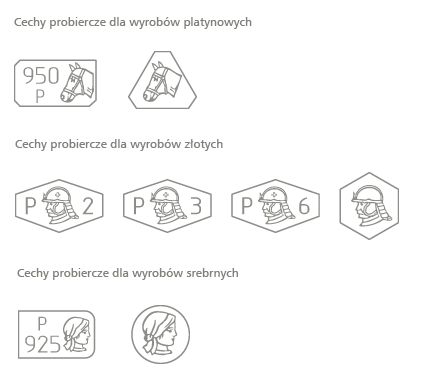
According to the law in force, products made of platinum, gold and silver offered to the Customer must have the appropriate hallmark stamped by the Assay Office. This contains information about the type of precious metal from which the product is made (this is indicated by an appropriate graphic symbol) and the purity, i.e. the content of the precious metal in 1000 units of the product. The relevant letter also informs about the place where the product is marked, for example - P - stands for the Poznan Assay Office. Products made of platinum or gold weighing less than one gram and silver products weighing less than five grams a piece - are not subject to mandatory hallmarking. The marking of delicate jewellery products weighing more than one gram is also waived in cases where the stamping of the hallmark may damage them. Such jewellery should have an appropriate certificate containing information corresponding to the appropriate hallmark for the product. Sometimes they are also marked by laser engraving.
What to know about silver...
Silver jewellery
The oldest jewellery known to man dates back some 22,000 years. Our jewellery is from the 21st century! In ancient times, in addition to its utilitarian and decorative function, jewellery was also an instrument of sorcery. Which is exactly what it is today. Our jewellery will enchant your world.
What is worth knowing?
Silver is an extremely malleable metal (slightly harder than gold), with a shiny lustre that can be easily polished. It has the highest electrical conductivity of all metals. Pure silver has the highest thermal conductivity, the brightest colour and the highest reflectance. It was known as far back as antiquity and has been valued as a precious metal for years, used as currency and, above all, for the manufacture of jewellery. To this day, it still reigns supreme in the jewellery arts, taking on the most fanciful and unusual shapes.
The only silver sample available on the Polish market is 0.925, which means that in 1000 alloy mass units, 925 is pure silver. Thanks to its relatively low price compared to gold or platinum, it remains the most popular raw material for making jewellery. On the other hand, due to its properties, it assumes the most varied forms and blends perfectly with all kinds of beads, zircons, coloured stones and enamel. It can also be gold-plated or rhodium-plated.
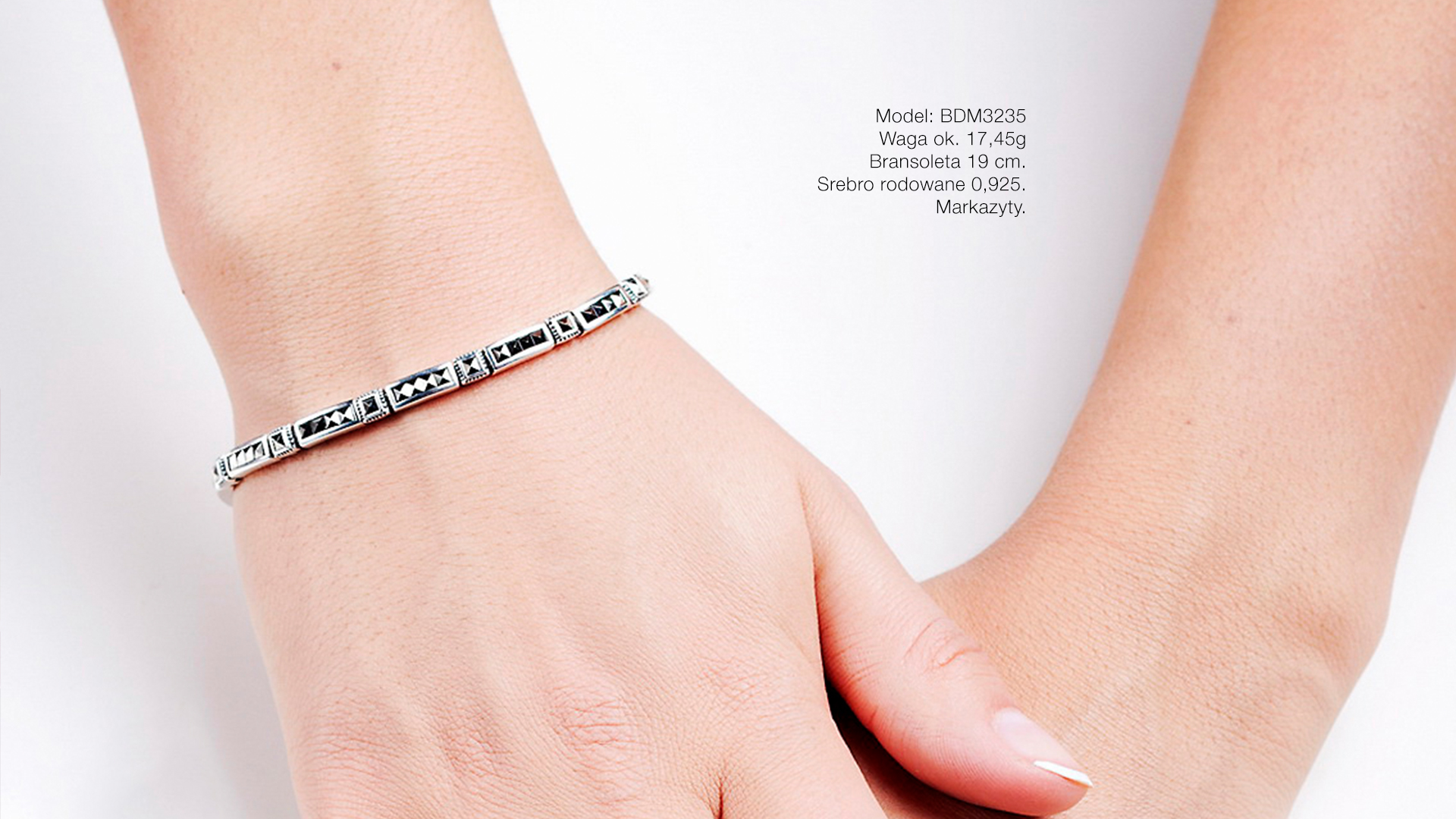
Rhodium plating involves coating another metal with a layer of rhodium. Rhodium is a very rare element found in nature. It is a silver-grey precious metal, resistant to water, air and acids, so jewellery covered with it remains unchanged for a long time. Rhodium is used in gold and silver to increase hardness, shine and weather resistance and to enhance and maintain the bright white of white gold. Unfortunately, after several years of regular jewellery wear, the rhodium may start to wear off, in which case it is advisable to cover the jewellery with a new layer of this precious metal in a reputable goldsmith's workshop.
Test marks
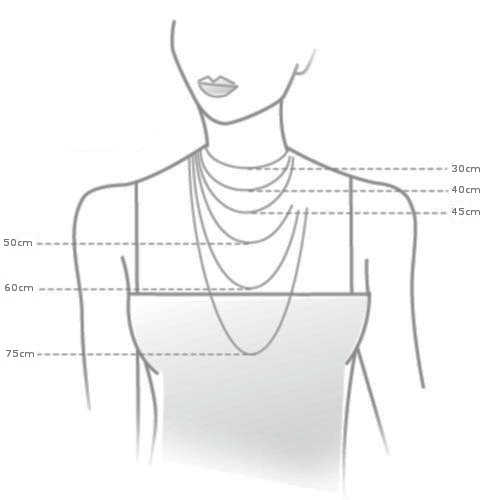
Typical chain and bracelet sizes
Within each jewellery range, there are the most common, most sought-after sizes, and these are:
Women's chain - length: 45 cm (and 42 and 50 cm)
Ladies' necklace - length: 42 cm
Women's bracelet - length: 19 cm (and 18 and 21 cm)
Men's chain - length: 55 cm (and 50 and 60 cm)
Men's bracelet - length: 21 - 23 cm
How to care for jewellery...
With respect for jewellery
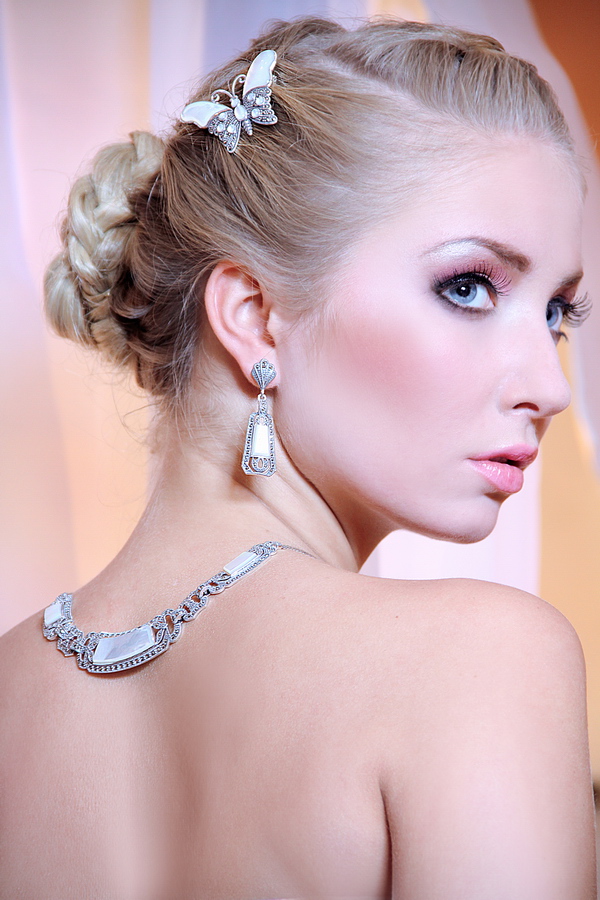
Authentic gold and silver jewellery, especially with precious stones, is like a dress from Chanel, so treat it with tact.
Precious and natural stones and pearls that adorn jewellery are particularly prone to falling out, cracking, chipping as a result of bumping, squeezing, trampling, snagging, and other damage as a consequence of various random events. Jewellery should be removed before doing household chores, before going to bed, before participating in sports and other activities where it may be damaged.
When using thin, delicate chains, great care must be taken. At the slightest snag, they can break or deform, even while sleeping. Once the chain has been removed, it should not be bent or rolled too tightly, as this can cause it to become permanently deformed or kinked.
How to care for your jewellery
1 The beauty of jewellery is durable, but at the same time delicate and fragile. Only by following the right recommendations will your jewellery enjoy its brilliance for a long time. Most jewellery designs are harmed, for example, by direct contact with water, whether from the tap, seawater or other bodies of water. The ingredients in the water can affect the appearance of the jewellery: it can lose its shine and become discoloured. This is particularly true of pearls and mother-of-pearl, which are delicate and sensitive. Getting jewellery with marcasites wet can cause them to fall out. Any type of jewellery should be removed before bathing or washing dishes.
Ingredients in detergents used in the kitchen and bathroom as well as in cosmetics: varnishes, deodorants and perfumes can cause discolouration of jewellery or the skin where it comes into contact with jewellery. In most cases, jewellery is not made of pure bullion, but of its alloys, which react with many different substances. Chemicals can also harm jewellery pieces made of natural or organic stones (pearls, amber), causing them to tarnish or delaminate. Therefore, jewellery should be protected from direct contact with them, for example by using cosmetics before putting on jewellery.
3 It is very important to store your jewellery properly. Each piece of it should be wrapped in a soft cloth and tightly closed in a separate bag. This will prevent it from getting damaged, dusty, etc. Special caskets, offered in jewellery shops, are a good place to store jewellery. It is advisable to have your jewellery professionally cared for from time to time.
4 It should be avoided that the surfaces of jewellery designs finished in diamond, satin, gold, rhodium or patina - which form only a thin outer layer of the product - are exposed to abrasion as their structure may be permanently damaged or worn away.
5 The best care treatment is to clean the jewellery of dust on a regular basis. The use of a special jewellery care wipe is recommended. Do not clean jewellery that is already heavily soiled yourself - especially with cleaning and polishing agents. From time to time, you should take your jewellery to a jeweller for professional care.